Thursday, December 18, 2014
The Silence of The Night
I was quite surprised about at Elie in the show with Oprah and his feeling toward the silence in the camp. In his book, He is quoted saying he would never "...forget the
little faces of the children, whose bodies I saw turned into wreaths
of smoke beneath a silent blue sky". I always thought that the silence he felt that night hurt him even more. All of us sometimes experience something so horrible and shocking, that the silence feels unnatural. It's as if we want the forces of nature to intervene and make everything right, but when they don't, we feel as if we want to break the silence and scream. Why would Elie want to feel that silence again during that visit? wouldn't that bring back painful memories of what he saw?

Friday, December 12, 2014
18 Badass Women You Probably Didn't Hear About in 2014
http://www.buzzfeed.com/rossalynwarren/badass-women-alert
This is an article about some really cool breakthroughs and achievements of some notable women in the past year. The achievements range from a 13 year old girl calling out a magazine for their depiction of women to a woman defying the Taliban. One of the greatest things about this article is it that it depicts alot of amazing women of different ethnic backgrounds, which is something that you don't see often. With 2014 nearing an end, there has been alot of big strides forward in the feminist movement. Countless celebrities have publicly declared themselves feminists, it's becoming more and more "socially acceptable" for women to not shave their body hair, and there has been a huge surge in girl to girl positivity. Yes, these things may seem small in comparison to some of the horrific things happening around the world. But, these things are the first few stepping stones to a future with equal rights for men and women (and transgendered men and women, and non gender binary persons as well) and overall acceptance of each other.
This is an article about some really cool breakthroughs and achievements of some notable women in the past year. The achievements range from a 13 year old girl calling out a magazine for their depiction of women to a woman defying the Taliban. One of the greatest things about this article is it that it depicts alot of amazing women of different ethnic backgrounds, which is something that you don't see often. With 2014 nearing an end, there has been alot of big strides forward in the feminist movement. Countless celebrities have publicly declared themselves feminists, it's becoming more and more "socially acceptable" for women to not shave their body hair, and there has been a huge surge in girl to girl positivity. Yes, these things may seem small in comparison to some of the horrific things happening around the world. But, these things are the first few stepping stones to a future with equal rights for men and women (and transgendered men and women, and non gender binary persons as well) and overall acceptance of each other.
Learn about "Confirmation Bias"
Check this out...
http://www.latimes.com/opinion/op-ed/la-oe-rivers-confirmation-bias-race-20141212-story.html
http://www.latimes.com/opinion/op-ed/la-oe-rivers-confirmation-bias-race-20141212-story.html
After Schindler Documentary
Today we watched a documentary that was made in the 1980's. We started coming onto the topic of whether or not when someone you love is accused of something do you defend them. In Goeths mistress' case, she felt the need that she had to defend her lover. I believe that she thought that all the accusations that were against her lover, were also against her. She was personally upset and angry when asked with whether or not Goeth hated the Jews. I believe the only way she could live with herself and how she let jews get murdered in front of her was by defending her lover.
UN Power
Recently we have been talking a bit about the UN and its power after World War II. After WW2 there was a lot of questions as to how the people who perpetrated the Holocaust would be punished. Some people believed that they should be killed on the spot with no trial. After much deliberation the UN decided to hold a fair trial for the criminals of the Nazi party. When this decision was made and the trial happened, it gave immense power to the UN. The only problem that I can see with this power is the lack of power to enforce it. The UN may have a lot of power but they have no force that can make sure people follow those rules. I believe until the UN can enforce these rules, there power will be only a fraction of what its true potential is.
Holocaust Camp Song
Separated from the world by barbed wire,
We’re rounded up from everywhere
The longing woven into our hearts,
Throbs like a ringing bell.
You with the striped rag on your back,
Could you forget who you are—and where?
They stitched a number to your breast,
A red triangle and the letter “P”.
And your shaved head reminds you,
Of your burden of sins unknown,
And you yearn for the day
When your will and your purpose return.
Neither stars nor sun bring you happiness,
Neither day nor night yields joy.
You stand and wait, dressed in stripes and shaved bare;
With thousands of others like you.
The words of this song are stained with our blood,
Within them are sorrow and grief,
Yet your camp song will carry beyond these barbed wires
To a distant place unknown to you.
Yet your camp song will carry beyond these barbed wires
To a distant place unknown to you.
Harsh Truth about Humanity
Finishing Schindler's list has opened my eyes to the harsh and brutal truth about the Holocaust. Before watching Schindler's list I didn't have something that I could visually use to understand the Holocaust. Seeing how Nazis treated people, showed me the truth about humanity and how humans react during times of struggle. Although their was a lot of horrible things going on at the time, because of this movie I have seen that there are good people in the world. Even in all the hate and destruction, people like Schindler emerge as heroes. But, this also shows us the brutal truth about the war. The fact that people could kill and do such horrible things to just normal people shows me that we are capable of beautiful and horrible things.
OJ simpson case
I know that we studied the OJ Simpson case a while ago, but I wanted to share my opinion on it. I believe that in the criminal trial, the outcome was correct. I definitely believe OJ committed these murders, but there was so much doubt that he couldnt be convicted. There was so much evidence that he committed the crime, yet the prosecutors either poorly explained it to the jury, or didnt even bring it up at all. The fact that they let oj put the gloves on himself was a huge mistake. I completely understand the outcome of the criminal trial because there was a lot of reasonable doubt, including a lying policeman, not fitting gloves, and suspicious lab work. I believe, however, that the civil trial brought justice to the crimes. The prosecutors did a better job, the judge was much more strict, and the jury was not biased. Although he couldnt be put in jail, he could be stripped of almost everything he owned. I think that if he couldnt be put in jail for life, that this was the second best punishment.
Finishing Schindler's List
At the beginning of the movie, we knew Schindler as a business man who only cared about making money, and saw the jews as an opportunity to finally become successful. He was a Nazi and made connections very early on with powerful men in the SS. He was able to get Jews from Krakow to make pots and mans for the war. The Jews who worked for Schindler saw the factory as a haven, and Schindler began to give more and more people jobs so they wouldn't risk being killed by Goeth. After a while, he began to realize that these Jews were actually humans, and that they didn't deserve to die. He knew that everyone from plaszow was going to be sent from Auschwitz, so he bought of over 1000 Jews to go work in his "camp" in the Sudetenland. This story shows that even in times of evil, there will always be people who realize what is happening and will do the right thing. I really liked the fact that most of the movie was in black and white, i feel like it gave a deeper meaning to the story.
United Nations
So this week we talked about what happened post WWII and the creation of the UN. The UN is a peaceful international organization comprised of 193 countries. Their goals are to maintain international peace, promoting human rights, protecting the environment, and providing aid in cases of famine, national disasters, and armed conflict. They are supposed to prevent and stop a genocide from ever happening again, yet we have sen the UN fail in doing so with the Rwandan genocide. The main reason I believe that the UN will never successfully stop anything from war to genocide from happening is because they have no power. They are a peaceful organization, so they cannot physically stop countries from committing the things that the UN tries to prevent. I believe that in order for the UN to actually stop anything, they need to have UN bases in every participating country and create a military for each base. This will destroy the entire idea that its supposed to be peaceful, but I dont think that the UN will be able to function properly without it.
Thursday, December 11, 2014
A semester in review
Over the past 3 months, in both big and small group, we have learned about a myriad of topics. From Machiavelli's "The Prince" to Marcus Dupree to Nazi Germany. One of the more interesting aspects of our class is the ability to study such diverse topics and to see how they develop within themselves and to see how they develop in relation to each other. In the spirit of expanding our knowledge, I would like to introduce one of Plato's allegories to you all.
Imagine, a cave and let us assume that a person is inside the cave and is bound such that he can only see directly in front of himself. Behind him is an exit to a cave and a fire above the exit that casts shadows on the wall in front of him. Imagine, a dog walking behind the bound man, but in front of the fire, causing a great shadow on the wall. The bound man whom has only ever seen the shadow of the dog assumes that the shadow of the dog, is indeed the dog. Similarly, because the man only has a small vantage point, he assumes that the shadow of all the objects are indeed the objects themselves. However, when the man is released from the cave he is able to see a dog. Now that his vantage point is widen, he knows what a real dog is, not the shadow of a dog as before. This principle of enlightenment can be applied to any and every object. The primary notion of the allegory of the cave is that once a person has become enlightened he cannot go back to being unenlightened.
This is a very powerful notion and I think it applies heavily to our class. Global Connection has allowed us to be unbound from our "caves" and has broaden our view. It has enlightened us on many subjects, and now that we know the truth, we can never become unenlightened again.
Schindler's List -- Haiku
Liegt fur Die Juden
Halt! Achtung! "Arbiet macht frie"
The List Provides Life
My opinion of Schindler's List
I wanted to take some time to talk about the movie we just finished watching, Schindler's List. I want to mention the importance, at least in my opinion as to why the director decided to include a limited amount of color in the development of the movie. To me, this movie was meant to be in black and white in order for the audience to get a better grasp of what was going on, since in fact color does tend to distract us many times, we notice this level of distraction mostly in action movies, since there are constant explosions going on. Whereas if a movie holds it plot in black and white, we can focus on the main message of the movie, we can let our imagination fill in the colors that the camera doesn't show. It was rather an incredible decision to make this movie in black and white since it completely captivated me. Not only was the movie fantastic, but the use of color in specific parts made us realize the importance that it holds in the plot of the movie, or in the experiences that the characters were facing. For example the little girl with the red coat, in my opinion, the moment that Schindler saw her at the camp, killed and headed to the crematorium, that was the turning point for Schindler, since he realized the almost inescapable faith that the Jews were facing, thus turning from a bystander, to an up stander. This movie and its limited use of color was in fact, sad and depressing, but motivating at the same time due to Schindler's righteousness.
Schindler and Flacke
Nazi Germany, is quite possibly one of the most morally and ethically bankrupt time periods in all of recorded history. Never before had such mass murder occurred in such a short time period. As countless German SS and Gestapo members continually withdrew from a moral bank account that would ultimately go into debt. Amidst all the morally bankrupt German Nazis, two men rose above the situation and remained morally steadfast, these men were Schindler and Flacke.
Schindler was a wealthy German man who initially set out to profit on the war. However, throughout the movie, Schindler begins to develop a fondness for the Jews and also begins to realize just how awful the actions of the Nazis were. Some time in the movie, Schindler's goals shift from self gain and monetary profit to saving as many Jews as possible. Schindler's actions saved over 4,000 people directly and tens of thousand more decedents of these people.
Similarly, in the Babice Labour Camp or "island of peace" as it was affectionately known, a man named Flacke ran a clean and good camp. Flacke did not succumb to the evil that surrounded him and ran a camp that was so "nice", the females in the camp called him "daddy".
I admire both Flacke and Schindler for being able to act morally in such a bleak and immoral time period. The just actions of both these men saved thousands of live and thousands more to come.
Schindler was a wealthy German man who initially set out to profit on the war. However, throughout the movie, Schindler begins to develop a fondness for the Jews and also begins to realize just how awful the actions of the Nazis were. Some time in the movie, Schindler's goals shift from self gain and monetary profit to saving as many Jews as possible. Schindler's actions saved over 4,000 people directly and tens of thousand more decedents of these people.
Similarly, in the Babice Labour Camp or "island of peace" as it was affectionately known, a man named Flacke ran a clean and good camp. Flacke did not succumb to the evil that surrounded him and ran a camp that was so "nice", the females in the camp called him "daddy".
I admire both Flacke and Schindler for being able to act morally in such a bleak and immoral time period. The just actions of both these men saved thousands of live and thousands more to come.
Final Thoughts about Schindler's List
Today we finished watching Schindler's List in class and I have really enjoyed watching this movie throughout the past week. It was really interesting to see how Schindler developed throughout the movie and how he had changed by witnessing and being involved in the Holocaust. By the end of the film, Schindler realizes that what was being done by the German soldiers to prisoners was not humane. One of the last scenes of the movie that I found really interesting was when Schindler was about to flee and he starts to breakdown. Schindler starts thinking that if he had given more money, gold, and valuable objects to give away he would have even been able to save more lives. I think this was a huge moment for Schindler. He realizes that he had done something great and saved many lives, but he wishes he could have done more. It took Schindler a long time for him to realize that what the German soldiers were doing was wrong and that no one should be treated that way. In this moment, I think this is when Schindler wishes he had realized this sooner. This demonstrates Schindler's character a lot because even though had save thousands of lives, he hoped that he could have saved more.
Thursday 12/11/14 large group
Today we finished Schindler's List. When we picked up, Schindler had just finished his list and his plan to move many Jewish prisoners to his new labor camp. At this point, Schindler has fully changed from a bystander to an up stander. He is spending extreme amounts of money to save the workers, because he must bribe the SS and pay to run his own camp. You can tell that at this point, Schindler hates what the Nazi party is doing, and his goal it to run the munitions factory without producing a single working shell. This is because he wants the Nazis to lose the war, which would free all of the Jews he cannot save himself. When the war ends and Schindler has a talk with all of the people he saved, it is showed that Schindler truly saved people for the right reason, and not to make money. He expresses that he will most likely be arrested because he was connected to the Nazi party and utilized slave labor. This story showed that during this extremely horrific time, there were still some good people who saw what was going on and tried to help.
Schindler's List
Finishing up the movie today in class we finally got to see how it all ended for Schindler and the group of Jews he saved. Although the movie was based on such a terrible time in our history Steven Spielberg was still able to capture the moment and still tell a really amazing story. The part that I found most interesting was when Schindler made a speech to his workers that at midnight they would be free but then he would be hunted. The change in roles surprised me and it showed how strong of a bond the workers had with Schindler. He had saved their lives by keeping them safe, and when Schindler had to go on the run they all signed a paper showing proof of how Schindler helped them. This leads me to ask what was your favorite part of the movie or which part fascinated you the most?
Wednesday, December 10, 2014
Wednesday Block summary
Today in the block period we continued to watch the Nuremberg trials documentary, as well started to watch a similar documentary about the Vietnam War. Both of the videos showed what happens when someone commits a war crime. All of the war crime trials we have viewed there has been a common theme of who is responsible when many people are involved in a crime. It is hard to decide whether to charge the individual listening to orders, or the person who is commanding them. In the case of the Nazis, almost every SS officer involved was charged with something, if they were found. It was very easy to prove that the higher up officers had committed war crimes because there had been so much evidence available proving that they did. In the Vietnam war with the My Lai massacre it was slightly different. The highest up commander claimed that he did not know what his men were doing, and when he realized what they were doing was wrong he stopped them right away. It was a big question whether or not he should be responsible for the massacre. He told his troops to destroy everything, kill all the livestock, poison the wells, and kill all people, but the people had turned out to be innocent. Because the soldiers were told that everyone at the compound were enemies, upon their arrival they walked in believing everyone was enemies which allowed this massacre to happen.
They had pre judged who they were up against so it was hard to change their beliefs and think that they were all innocent civilians. Because both the individuals and the Commanders in both situations had reasons they could be innocent or guilty it was hard to determine who actually committed the war crime.
They had pre judged who they were up against so it was hard to change their beliefs and think that they were all innocent civilians. Because both the individuals and the Commanders in both situations had reasons they could be innocent or guilty it was hard to determine who actually committed the war crime.
Tuesday, December 9, 2014
Sir Nicholas Winton
We have discussed in class the idea of defiance and "choosing to be good or evil". Whether it be an SS officer such as Flacke or Shindler, or a citizen that defies Nazi orders, the difference that an individual can make is immense.
I recently came across the story of Sir Nicholas Winton, a young stockbroker from London, and how he saved the lives of 669 children refugees. Winton organized the transportation of children from Prague into the UK.
This 60 Minutes focuses of Sir Nicholas Winton and his story:
https://www.youtube.com/watch?v=c0aoifNziKQ
I recently came across the story of Sir Nicholas Winton, a young stockbroker from London, and how he saved the lives of 669 children refugees. Winton organized the transportation of children from Prague into the UK.
This 60 Minutes focuses of Sir Nicholas Winton and his story:
https://www.youtube.com/watch?v=c0aoifNziKQ
WWII Factories
Similar to Schindler's factory, many factories during World War II began producing supplies for the war effort.
Here are a few videos that focus on these efforts:
German factories:
https://www.youtube.com/watch?v=eQ3YZ4foFHk
US factories:
https://www.youtube.com/watch?v=nfdIKOZyzBQ
Extra footage:
https://www.youtube.com/watch?v=CW6IxDtMvT4
Here are a few videos that focus on these efforts:
German factories:
https://www.youtube.com/watch?v=eQ3YZ4foFHk
US factories:
https://www.youtube.com/watch?v=nfdIKOZyzBQ
Extra footage:
https://www.youtube.com/watch?v=CW6IxDtMvT4
Immigration to America
While on the topic of the Holocaust and the mistreatment of the Jewish people as well as countless minority groups, I can contribute a personal perspective:
My mother's grandmother, Ida, and her mother and sister immigrated to America from Russia in 1908. They were amongst the millions of people trying to escape the religious, racial, and political persecution in Europe. Ida's family was extremely poor and could not provide education or the basic necessities. This was the case for many Jewish people living in the Russian Empire during the 19th century. After the assassination of Tsar Alexander II, the Jewish population in Russian were subject to "pogroms". Pogroms were "large-scale, targeted, and repeated anti-Jewish riots". Ida, her mother, and her sister traveled to America in the steerage class of a steamship in an attempt to escape the violence. However, America's immigration regulations were becoming stricter due to the massive increase in immigration. Therefore, Ida's sister was not allowed off the boat due to her hunchback. Deciding to accompany Ida's sister, Ida's mother traveled back to Russia, accepting their unfortunate fate. This left Ida alone in an unfamiliar country at the age 16. There was a family that had been arranged to house Ida. However, this family treated her like a slave and eventually kicked her out of the house. Luckily, she met a woman named Sarah who took her in and let her live with her. Eventually, Ida met and married Sarah's son Morris.
My mother's grandmother, Ida, and her mother and sister immigrated to America from Russia in 1908. They were amongst the millions of people trying to escape the religious, racial, and political persecution in Europe. Ida's family was extremely poor and could not provide education or the basic necessities. This was the case for many Jewish people living in the Russian Empire during the 19th century. After the assassination of Tsar Alexander II, the Jewish population in Russian were subject to "pogroms". Pogroms were "large-scale, targeted, and repeated anti-Jewish riots". Ida, her mother, and her sister traveled to America in the steerage class of a steamship in an attempt to escape the violence. However, America's immigration regulations were becoming stricter due to the massive increase in immigration. Therefore, Ida's sister was not allowed off the boat due to her hunchback. Deciding to accompany Ida's sister, Ida's mother traveled back to Russia, accepting their unfortunate fate. This left Ida alone in an unfamiliar country at the age 16. There was a family that had been arranged to house Ida. However, this family treated her like a slave and eventually kicked her out of the house. Luckily, she met a woman named Sarah who took her in and let her live with her. Eventually, Ida met and married Sarah's son Morris.
Night Reflection
There was a quote in the reading assessment that talked about how the narrator felt when he saw his father be hit right in front of him. This idea came up again in the more recent reading when Idek, a German soldier takes out a lot of his anger on the prisoners. Elie was first beaten by Idek and his next victim was Elie's father. Elie was once again shocked by how he had reacted to see his father being beaten. He had no reaction and knew that being in these camps had truly started to change him. When I read this, I was not surprised that Elie did not try to step in and stop Idek because just like the first time he saw his father being beaten, Elie knew there was nothing he could do. By living in these camps for so long, Elie starts to see absolutely no point in rebelling or standing up to the German soldiers because he knows it will bring no good. The camp has made him so weak and broken that he can't even react to seeing his father being beaten right in front of him.
12/09/14 Class Summary
Small group:
Today in small group we started a new documentary about the Nuremberg Trials. The trials were in place to charge the Nazi party leaders with various crimes. The crimes included Conspiracy to start a world war, crimes against peace, war crimes, and crimes against humanity. The idea that the trial was ran by the allies, who had just defeated Germany, brought up many questions. A main question was how this trial would be fair to the defense because most countries did not like the Nazis at this point. Also what the punishments should be given out to each individual defendant.
Large group:
We continued to watch Schindler's List today. In the film, we see Schindler slowly move from being a bystander in the Holocaust, to an upstander. He originally hired all the Jews so that he could get maximum profit from free labor, but because Stern is hiring workers who otherwise would be killed, Schindler starts to get the reputation as a savior. As he sees that he is helping so many people, he starts to help more and more people until today when we saw that he is in the process of buying mostly everyone from the labor camp with his own funds. This shift from bystander to upstander can be very dangerous for Schindler because if he is caught helping Jewish people he will be jailed or even killed.
Today in small group we started a new documentary about the Nuremberg Trials. The trials were in place to charge the Nazi party leaders with various crimes. The crimes included Conspiracy to start a world war, crimes against peace, war crimes, and crimes against humanity. The idea that the trial was ran by the allies, who had just defeated Germany, brought up many questions. A main question was how this trial would be fair to the defense because most countries did not like the Nazis at this point. Also what the punishments should be given out to each individual defendant.
Large group:
We continued to watch Schindler's List today. In the film, we see Schindler slowly move from being a bystander in the Holocaust, to an upstander. He originally hired all the Jews so that he could get maximum profit from free labor, but because Stern is hiring workers who otherwise would be killed, Schindler starts to get the reputation as a savior. As he sees that he is helping so many people, he starts to help more and more people until today when we saw that he is in the process of buying mostly everyone from the labor camp with his own funds. This shift from bystander to upstander can be very dangerous for Schindler because if he is caught helping Jewish people he will be jailed or even killed.
Over the past few days we have been watching Schindler’s List, and throughout the film we have seen how Amon Goeth's personality changes so
drastically. At one moment he is showing the darkest and most ruthless side of
him, shooting at the Jewish prisoners and beating his maid senseless. However,
we have also seen how he truly feels for his Jewish maid, telling her how he
feels affection for her, and how he can pardon his prisoners for failing simple
tasks that would usually get them killed. Near the end, Goeth even agrees to
sell his Jewish prisoners to Schindler, including his maid who he cares so
dearly for. But what I want to know is, why does he change so drastically
throughout the movie? Does he know what he is doing is wrong and has
conflicting ideas about exterminating the Jews, like so many other Nazi
officials? But if he truly felt deep down that what was going on in the camp
was so wrong, why didn't he stop it? During our reading in The Kingdom of Auschwitz, we read of certain Nazi officials who did
not treat their prisoners so cruelly and were never punished by the Nazis, such
as the camp that was ran by Flacke. Flacke not only didn't treat his prisoners
like they were subhuman, but treated them so well that he was called “Daddy” by his
prisoners. So why didn't Goeth do the same?
Schindler and Stern
In the beginning Schindler and Stern had very different views. Schindler being a business man had a somewhat selfish view of doing things. Stern recognizing that Schindler was German always was skeptical of Schindler's plans. We could see this when Schindler offered Stern drinks yet time and time again Stern would deny his offer. As time went on there needs for each other quickly evened out. Stern needing Schindler to keep him alive along with other Jews. Schindler needed Stern in order to run his business effectively and make money. In class today we saw yet another change in their relationship. There needs for each other were still present but they connected on another level when Stern finds out Schindler has agreed to buy almost all the people living in the camp from Goeth. Stern must have realized at this point that Schindler really cared about these people, although he is just making another factory that fact that he spent so much of his money to buy the workers showed his sympathy. Schindler had said himself he had more than enough money to move away and never work again but he spent the money he earned from the workers to buy them back. This potentially saved them from death for the time being because the rest of the workers were sent to Auschwitz.
Monday, December 8, 2014
12/08/14 Class summary
Small group:
Today in small group we talked more about questions in the "Kingdom of Auschwitz". We talked about how it was possible for the death/ concentration camps to be so private. The idea that the Germans were taking people and mass killing them as well as making them work until they die from exhaustion was very unbelievable to many people. Like in night when Moshe the Beadle tells people what is going on but nobody believes him and thinks he is crazy. He is seen as crazy for trying to spread such crazy stories but in reality its true. He was almost like an Alex Jones of that time, so it is understandable how what was going on was an exaggeration or a lie.
Large group:
We continued to watch Schindler's List and the concept of disbelief was further shown. Even people who where working in labor camps could not believe that in other camps people were being mass exterminated. It was too hard for people to grasp because they simply did not want to believe what they were hearing. Also the movie showed how Germans could feel connections to Jews although they had been taught that Jews were vermin, and sub-human. This was shown when the main labor camp leader realized that his Jewish maid was actually a nice person, who had skills.
Today in small group we talked more about questions in the "Kingdom of Auschwitz". We talked about how it was possible for the death/ concentration camps to be so private. The idea that the Germans were taking people and mass killing them as well as making them work until they die from exhaustion was very unbelievable to many people. Like in night when Moshe the Beadle tells people what is going on but nobody believes him and thinks he is crazy. He is seen as crazy for trying to spread such crazy stories but in reality its true. He was almost like an Alex Jones of that time, so it is understandable how what was going on was an exaggeration or a lie.
Large group:
We continued to watch Schindler's List and the concept of disbelief was further shown. Even people who where working in labor camps could not believe that in other camps people were being mass exterminated. It was too hard for people to grasp because they simply did not want to believe what they were hearing. Also the movie showed how Germans could feel connections to Jews although they had been taught that Jews were vermin, and sub-human. This was shown when the main labor camp leader realized that his Jewish maid was actually a nice person, who had skills.
Uplifting Holocaust Article...
Check it out if you'd like...
http://www.latimes.com/local/california/la-me-beat-holocaust-friendship-20141207-story.html#page=1
http://www.latimes.com/local/california/la-me-beat-holocaust-friendship-20141207-story.html#page=1
Saturday, December 6, 2014
Choices at Auschwitz (by Danny Rabin)
Hi, everyone. This is Danny Rabin writing. Long story why I'm using Jorge's account, but anyways this is Danny.
While reading The Kingdom of Auschwitz this week, we read the story of a Nazi officer named Flacke who chose to treat his prisoners with kindness rather than cruelty. This reminded me of a story that my former Hebrew teacher told me years ago about when her mother was interred at Auschwitz. She worked in a factory assembling machine guns. It was considered a good job to have and she was thankful she wasn't doing hard labor. She would sit at a table and put the firing pin in each gun, then when she was done, she would put the gun in a drawer which opened on both ends. One day, an SS officer came in to inspect the factory. He walked around and when he came to her station, he started yelling at her furiously. My teacher's mother was absolutely terrified. She didn't speak German so she had no idea what he was saying and she had seen this sort of thing happen before and it usually ended with the person being yelled at being beaten or even shot. The officer finished his tirade and stormed out of the room. Before he left, however, he discreetly pointed at the gun drawer and smiled. My teacher's mother looked in the drawer and saw a fresh apple. The officer had slipped her an apple! One apple may not seem like much, but she was emaciated and to her, an apple seemed like a feast. She believes that there is no way that she would have survived without the officer's kindness.
This story shows that, even when in absolutely horrible situations, people are capable of rising to the occasion and letting good triumph over evil. Like Flacke, this officer had a choice of whether he wanted to do nothing, do something awful or do something good. He chose to be an upstander and do something seemingly minor, but which had such great results. He saved a young girl's life because he chose that he would rather do something good than evil. The stories of Flacke and this officer show that even at Auschwitz, sometimes the best in human nature could triumph and people were able to defy the pressure to treat other human beings with extreme cruelty and instead act out of altruism.
Thanks, Jorge for letting me use your account!
Schindler and Stern
At the end of big group, we stopped the at the scene where Stern was talking with Schindler for the first time after the liquidation of the ghettos. We also noted a change in relationship when Stern accepted food from Schindler for the first time at this point in the movie. We didn't look to far into this scene because the class ended, but I've been thinking about this change in character.
Either Stern has grown to like Schindler or he feels safer around him. In the former, it would mean that within the short amount of time that they actually have been together, Stern has begun to appreciate Schindler as a character. In the latter, Stern still thinks the same of Schindler, but because of all the SS around and the recent liquidation that occurred to transport them to Krakow, Stern is in a situation where he needs all the help he can get in order survive, and that he is using Schindler for this purpose. I don't know what his exact motivations are, so I decided to post it here to know what you guys think.
Either Stern has grown to like Schindler or he feels safer around him. In the former, it would mean that within the short amount of time that they actually have been together, Stern has begun to appreciate Schindler as a character. In the latter, Stern still thinks the same of Schindler, but because of all the SS around and the recent liquidation that occurred to transport them to Krakow, Stern is in a situation where he needs all the help he can get in order survive, and that he is using Schindler for this purpose. I don't know what his exact motivations are, so I decided to post it here to know what you guys think.
Friday, December 5, 2014
Summary of Thursday, 12/4 through Friday, 12/5
Large Group of Thursday
and Friday:
-Watched approximately
the first half of Schindler's List. Main point is that Oscar Schindler, a business
man, runs a company those aides the Nazi war effort by producing cooking pots
for the German army. He depends on members of the Jewish community to provide
labor and organization for his business, and as the Jews are deported into
concentration camps, Schindler's company suffers due to the loss of many of his
workers. He is, at this point, also developing sympathy for the Jewish
community.
Small Group (Friday):
- Finish the Kingdom of
Auschwitz article in the HHB reader.
Dr. Mengele: Story of the Seven Dwarves
Dr. Mengele was a evil doctor of the Auschwitz camp. He was known for his unusual experiments upon the prisoners.
The following is an article link about the story of 7 dwarves that endured his experiments.
-
-
-
-
http://www.dailymail.co.uk/news/article-2279410/How-seven-dwarfs-Auschwitz-fell-spell-Dr-Death-The-hideous-experiments-carried-Nazi-Josef-Mengele-seven-trusting-brothers-sisters.html
What we did on Dec 5th
Today in Small Groups we finished the Kingdom of Auschwitz questions up to question 25.
In Large Group we continued watching the Schindler's List. There was the introduction of a new SS officer that opened a work camp for the Jews. He moved all the Jews including Stern and Schindler's workers from the Ghettos to the camp. Any Jews that tried to hide the movement were shot. Schindler strikes a deal with the SS officer to allow him to have his workers, but Stern stays on the camp. The class ends with a show of Stern and Schindler getting more connected than before. Earlier in the film Stern never took Schindler's thanks such as drinks. But at the end of class Stern says thanks for the first time.
Thursday, December 4, 2014
12/04/14 class summary
Today in large group we started to watch the movie Schindler's List. It showed the early steps of "ethnic cleansing" like the separation of Jews into ghettos. It also showed how some people were trying to help other Jews by creating jobs for them. If they were considered valuable workers for the German war effort they could be saved from concentration/ death camps for the time being. The film also showed why the Jews did not try to fight back, because they believed that being in the ghettos was the worst it could get. In the train scene, the government inefficiency was shown when Schindler wanted his employee back, and gets it by threatening to send the german soldiers to Russia.
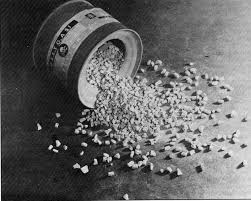
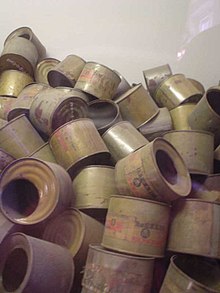
Brief info of Zyklon B
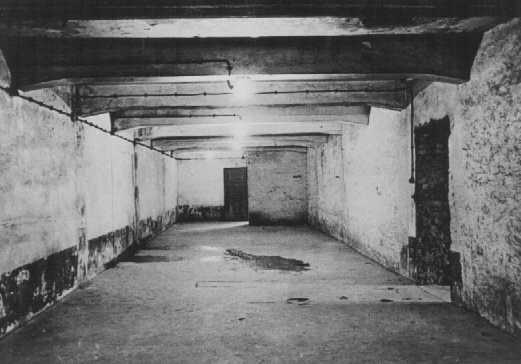
Zyklon B was a deadly modified pesticide used by the Nazis for the gas chambers. It is a modified form of hydrogen cyanide to be easily transported in canisters. It can be obtained from pits of fruits such as cherries, apricots, and apples. These pits emit this hydrogen cyanide slowly. 100 grams of crushed apple seeds can yield about 70 mg of hydrogen cyanide. Zyklon B provided the Nazis with an extremely effective genocide weapon which claimed millions.


Wednesday, December 3, 2014
Upon reading the first chapter of Night, it is very apparent where the rest of the story is going. It started out happy, but the story soon took a dark turn, as German military personell took over their community. It is obvious that people were unaware of the horrors that were in store for them. I was shocked that the people would not believe Mosche when he miraculously returned to Sighet. But the more I though about it, the more I realized that his stories were so outrageous and unbelievable, that it would be extremely difficult for anyone to believe such far fetched tales. The only reason we as readers believe Mosche, is because were are already informed about the Camps, Ghettos, etc...
Tuesday, December 2, 2014
Summary of Tuesday, 12/2
A brief summary of today's class for those absent:
Small Group:
-Read
Kingdom of Auschwitz to question 12 in the reflection. Focused on the
disorganized way that Auschwitz functioned as well as the Auschwitz hospital
and doctors.
Large Group:
-Watched
Nazi Documentary, Episode 6, approximately halfway completed. This section of
the episode went over the last efforts of the Nazis in WWII, particularly how
they allowed members of the "inferior races" to join SS forces. The
Nazis rallied new recruits behind the idea that they would go on to defeat
communism, an idea that they would later try to use to justify the entire
war.
The Nazis
Learning about the Nazis and how Hitler came to rule a big part of Europe has given me an new understanding of the Nazi era. My original thought of the Nazis was a complete lethal group during the 1940s that killed off many Jews and Nazi opposers. After watching the documentaries in class I was surprised to find how unorganized the Nazis really were. The Nazis seemed to be making it up as they went along. Even though Hitler had terrible views of what he wanted while ruling Germany he had very good leadership skills. One that stood out was when he put in charge specific Nazi leaders. He made sure that they did not favor each other so there was a small possibility of them joining together and taking over Hitlers role. If the Nazis had better planned how they were going to "ethically cleanse” Germany they would have killed many more than what they had accomplished with such little planning.
Monday, December 1, 2014
Night-Chapter 1 Reflection
After reading the first chapter a question came into my mind, would have more Jews survived and escaped if they had reacted a different way or defended themselves earlier and didn't try to ignore what was happening. The biggest surprise from reading the first chapter is The Jews of Sighet refused to believe what was actually happening at the death camps even after Moshe the Beadle told them about his experience there, I agree with the previous posts about admiring them for having an optimistic view on everything during such a hard time but at the same time I feel like in doing so they ignored the bigger problem and like Coca said previously its almost as if they were hiding from the truth, from reality. They refused to believe that the Nazi could possibly be this evil. It was also very intense and difficult to read as he described how terribly the Jews were treated during deportation.
Night-chapter one
During tonight reading I realized why people refused to believe that the Nazis would ever create such horrible atrocities. I realized this by the stories that Beadle was telling to the people of the community and no one would believe him. The stories he told seemed a little to unreal to the normal person so its understandable and it made it clear why people were not trying to escape. But, I do admire the way they tried to remain positive in such a hard time where everything is changing so fast from what they know.
Night Chapter 1
I actually have read this book before, but that was a few years ago so this was a good refresher. I think it's extremely thought provoking how they simply did not believe that something bad was going to happen to them. It's like what we talked about today in class; no one wants to believe that human beings could do these evil things to each other. It's very admirable how everyone tried to stay optimistic, and I think optimism played a big part in any one who survived being in one of the concentration camps. It's also interesting how religion plays a big part in the young boys life.
Night-Chapter one
After reading the first chapter I had many conflicting thoughts. I admired that they were able to be optimistic through the harsh situation but I also feel like they were just hiding themselves from the truth. I was also somewhat mad that no one listened to beadle. It bothered me because he came back not to save his own skin but to warn his community and he was ignored by those whom he was trying to save.
Chapter 1 reflection
I have seen a few posts about Moshe, so I want to talk about something else.
I noticed that the Jews where always optimistic, and always made excuses for why they would not be sent to concentration camps, and the Russians would come to save them. I think they had valid reasons for believing they would be spared until Moshe came to warn them about what was to come. The part about the reaction of the Jews that amazes me the most is that nobody in the town bothered to leave. I would expect for one or two families to leave because they believed Moshe, so this is the biggest surprise for me.
However, I don't understand why the Jews still thought nothing would happen to them when they where moved into the smaller ghetto. They saw what had happened to the previous occupants, and they managed to ignore this and think they where different from the people before them. While optimism is generally a good thing, I think this shows that an extreme of anything, including optimism can be disastrous.
I noticed that the Jews where always optimistic, and always made excuses for why they would not be sent to concentration camps, and the Russians would come to save them. I think they had valid reasons for believing they would be spared until Moshe came to warn them about what was to come. The part about the reaction of the Jews that amazes me the most is that nobody in the town bothered to leave. I would expect for one or two families to leave because they believed Moshe, so this is the biggest surprise for me.
However, I don't understand why the Jews still thought nothing would happen to them when they where moved into the smaller ghetto. They saw what had happened to the previous occupants, and they managed to ignore this and think they where different from the people before them. While optimism is generally a good thing, I think this shows that an extreme of anything, including optimism can be disastrous.
Chapter 1 Thoughts
I found it interesting how after Moshe the Beadle had told the town about what was happening, they didn't believe him. Perhaps they didn't want to believe the news. Instead, they deluded themselves into thinking he wanted pity, or that he was insane. They couldn't accept what he was saying as truth.
This attitude continued even after the Jews were rounded up and put in ghettos. Some were happy that they appeared to have their own little community, and I found it interesting how they set up their own Council, police, committees, etc. They were convinced that they would be allowed to remain there. I was also surprised to hear how many people had offered to move their family to safety, but they declined each offer. I can only guess that people didn't realize what really laid in store until it was too late.
This attitude continued even after the Jews were rounded up and put in ghettos. Some were happy that they appeared to have their own little community, and I found it interesting how they set up their own Council, police, committees, etc. They were convinced that they would be allowed to remain there. I was also surprised to hear how many people had offered to move their family to safety, but they declined each offer. I can only guess that people didn't realize what really laid in store until it was too late.
Night: Thoughts on Chapter One
The thing that struck me the most was the fact that no one believed Moshe the Beadle when he told the people around Sighet about what he had seen. People seemed to want to ignore his warnings and pretend like they were the thoughts of a madman. This made me wonder whether people were ignoring him to remain optimistic of what was happening or if they genuinely knew nothing of what was happening. Later, it mentioned that they were listening to The London radio and felt that it gave them heartening news that Germany might lose as well as the good news from the Russian front solidifying it. Was this heartening because they knew of what was going down to other Jews in Europe or because of the general knowledge that the Nazis believed the Jews to be inferior? If they knew that Jews were being killed, why would they ignore Moshe's warnings?
Night Chapter 1
The book goes by very quickly which is probably how it felt for the people in that situation. Like everything was happening so quickly but really slowly at the same time if that makes sense. Also its crazy how people kept convincing themselves to be optimistic.
Hitler Assassination Attempts
The following is a link to a list of the major attempts made on Hitler's life:
http://valkyrie.greyfalcon.us/hitlermurd.htm
http://valkyrie.greyfalcon.us/hitlermurd.htm
Summary of Monday, 12/1
A brief summary of today's class for those absent:
Small Group:
-Obtained Night by Elie Wiesel as well as reading guides and
reflection sheets
- Read first 3 pages or so of the Kingdom of Auschwitz
article in HHB reader which covered the first 3 reflection questions.
Large Group:
-Started the 6th and
final episode of the Nazi documentary which covered the beginning of the end
for Germany in WWII. Essentially, the Allies begin to push back into territory
previously invaded by the Nazis and the German cause gradually becomes
hopeless. Top German officials organize an unsuccessful assassination attempt
on Hitler’s life as a result.
Book Assignment pushed back until January 16th.
"Night" Chapter 1
After reading chapter one, I started thinking about the charade the German soldiers put on to the Jewish people before the ghettos and deportation began. When the German soldiers first invaded Hungary and the town that Wiesel lived, they were polite and considerate to their hosts, even bringing them chocolates. Due to the attitude the German soldiers had toward the Jews at that point, no one believed that they could harm them in any way. When the start of the arrests began, and the Jews were bustled into ghettos, and it showed the attitude change in the German soldiers. Although the Germans had to take part in herding and deporting the Jews, there could have been some soldiers, like the one who gave his hostess chocolates, who did not share the same attitude as his fellow comrades, but refused to go against the oath.
Subscribe to:
Comments (Atom)